Prague
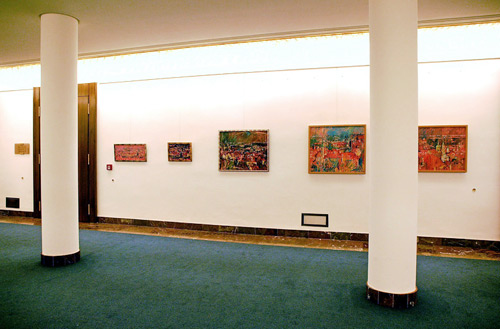
When we stand before Josef Fronk's series of paintings of Prague, our reflections may take two directions. We can either focus on the art-historical context associated with depictions of the city, and of Prague in particular, which would be an approach informed by specialist knowledge, or we can focus directly on the subject itself: the depiction of a city that we all know from experience.
In the first case, we would have to recall almost the entire tradition of European painting: views of ancient harbours vividly captured in the wall paintings of Pompeii; Jan van Eyck and Pieter Bruegel with their views of Dutch towns; Bellini, inspired by Venice; El Greco with his view of Toledo beneath a dark, stormy sky; Canaletto with his views of London; Turner's paintings of Venice; Bellotto, who painted views of Dresden; Corot, Pissarro and Monet; Schiele's depictions of Krumlov; and so on.
If we focus specifically on Prague, we must at least recall the paintings of Antonín Slavíček and Oskar Kokoschka's famous series. After this list of artists, however, the question inevitably arises as to whether anything can still be added to it, and whether every addition will be mere repetition. In the second case, which is concerned not with historical context but with how Prague appears to us now, we need not ask about artistic tradition and how to move beyond it in an original way. We are more likely to ask whether our image of Prague agrees with the artist's, and where they may differ. Both approaches have their merits, but both share one fundamental shortcoming: they lead us away from the paintings on display. The historical survey seeks to place what we see within the structure of an established cultural heritage. It is, in effect, a way of grasping what we see through concepts.
The second approach, which begins with our personal experiences, is shaped above all by our practical experience: our knowledge of Prague's topography.
Ultimately, however, the two paths - the conceptual and the practical - converge. We most often use concepts to find or establish regularities within the multitude of phenomena around us. In other words, we use them to reduce this multiplicity conceptually and bring it under practical control.
This practical and conceptual basis of our everyday experience means that, in the end, we do not linger long over the things we look at. Our gaze does not usually rest on an object for long. In everything that presents itself to us, we look above all for a recognisable, practically useful conceptual category: a concept under which we can place a thing so that we know how to use it. That is why we are so quickly done with everything: with works of art, with our view of nature, and with all the significant facts of life. It is enough, when standing before a painting of Prague, to recall the tradition of Slavíček and Kokoschka, or, more simply still, to say: yes, this is Prague Castle, here is St Nicholas and there is the National Theatre. That usually settles the matter.
But if we set aside our efforts to replace things with practically useful concepts, it becomes clear that only then can we really see things and the world. Our cognitive abilities will suddenly no longer serve merely to find a path through the world towards an attainable goal. Through this change of perspective, this pause, the cognitive abilities that we usually use as a lamp to see our way become a light that opens the world to us. Perhaps the simplest approach to Josef Fronk's paintings is to look at them with the awareness that art, even when realistic, is not an illustration of something else that exists outside it. It is not simply a matter of appreciating the novelty of an artistic variation on an old subject, or of correctly matching elements of the painting to buildings that exist in reality. Rather, we need to recognise that through art we form a particular and independent relationship with reality, and that art matters not so much for what it says as for the fact that it exists and that we are compelled to respond to it. We might respond precisely by pausing, for a moment, in our pursuit of attainable goals. It is enough to look at things with a certain intellectual contemplativeness and a thoroughness directed towards no particular end. This receptiveness to what exists will first reveal the beautiful things around us, but will eventually, perhaps, lead us into the most ordinary yet most intimate corner of our home: to what is hidden within our being.
It is strange, but in the end it seems that painting Prague and looking at paintings are also a kind of understanding which, precisely because it is not guided by practical motives, allows us to know and experience the things around us, and ourselves, much more intensely and deeply.