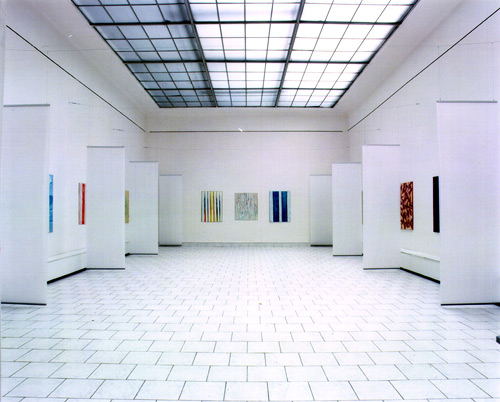
White Prayers
The collection of paintings on display, created last year, represents one phase in the work of the painter Josef Fronk. All the paintings share a basic structural similarity: white vertical bands run through an abstract field of colour. This vertical structure carries a visual order and, in the artist's conception, also has certain spiritual meanings. Josef Fronk understands abstract painting as an expression of emotional states that may also reveal deeper intuitive structures of our personality: as something capable of capturing the deeper, subtler layers of our life and world, and perhaps also of bringing us closer to the spiritual dimension of being.
His conception of abstract painting is therefore by no means purely formal. It is not limited to articulating the picture plane and working with elements of colour; it seeks to add a further spiritual or metaphysical dimension to this plane - in the literal sense, the surface of the painting. This also helps us understand the exhibition's title: White Prayers. Prayer is a form of communication in which a space of transcendence opens within this world, a space opened through a certain grace. This space of grace and transcendence is not entirely within our control. If I may speculate about prayer from a Christian perspective, I think its purpose is not to win God over so that he wants what we want, but that we pray so that he may lead us to want what he wants. I say this neither because I wish to deliver a sermon here nor because I want to interpret Josef Fronk's paintings as religious painting, which would misinterpret them. I wish only to clarify his fundamental disposition, his basic approach to making art. I think Josef Fronk wants to be led, through painting and through the emotionally experienced act of painting, to want what painting itself wants. Just as in prayer we address God as a person, he too wants painting to answer him and show him the way, and for painting itself to lead him to a revelation of what has so far been hidden from sight. In its general form - I emphasise for a second time: not in its specifically religious form - this dynamic and existential aspect of prayer, an expression of living faith, underlies Josef Fronk's conception of abstract painting.
Once we recognise this fundamental disposition, we can more readily understand certain aspects of his paintings and his practice. We realise that the pictorial elements he uses have meanings as well as visual qualities. The vertical articulation that gives a painting its basic order does more than organise its surface: it also represents a certain spiritual principle. The effort to draw lines precisely and sensitively is an effort towards precision of expression, seeking, through the brushstroke itself, to express a sensitive and restrained approach to reality. The same is true of colour: white and blue are spiritual colours, while red is the colour of vitality. In the blue, the technique of washing out the paint also reveals luminous depths through which the picture plane opens to our contemplation. This fundamental orientation helps us understand not only the visual aspect of the paintings but also the artist's own disposition and attitude to life. We should also remember that prayer has often been accompanied by sacrifice and fasting. I do not say this to make a hero of Josef Fronk's efforts or to present him as some saint of painting and martyr of art. I wish only to suggest that all these activities are, above all, open to the future, open to what is coming. In other words, I mean that Josef Fronk gives a great deal to the task he has set himself, and that we should continue to follow his work in the future.